
Basketball is easy to start and deep to master. If you are new, or you are watching your kid’s game for the first time, the rules can seem confusing. This guide covers the basics. Rules vary by league and level, such as NBA, college, high school, and youth, so check your league’s rulebook. The National Federation of State High School Associations (NFHS) publishes rules for U.S. high schools.
Warm up before you play and stop if something hurts. This is general information, not medical or coaching advice.
The goal
Two teams try to score by shooting the ball through the opponent’s hoop, which is 10 feet above the floor. The team with more points at the end of the game wins.
Scoring
- Field goal: 2 points for a shot made inside the three-point line.
- Three-pointer: 3 points for a shot made from behind the three-point line.
- Free throw: 1 point for each shot taken from the free throw line after certain fouls.
Players and positions
Each team has five players on the court. Traditional positions are point guard, shooting guard, small forward, power forward, and center, though modern basketball is flexible. Youth leagues may use smaller teams and different rules.
Starting and time
Games start with a jump ball or possession arrow, depending on the level. Games are divided into quarters or halves. Youth games may have shorter periods. A shot clock limits how long a team can hold the ball before shooting, in some leagues.
Moving with the ball
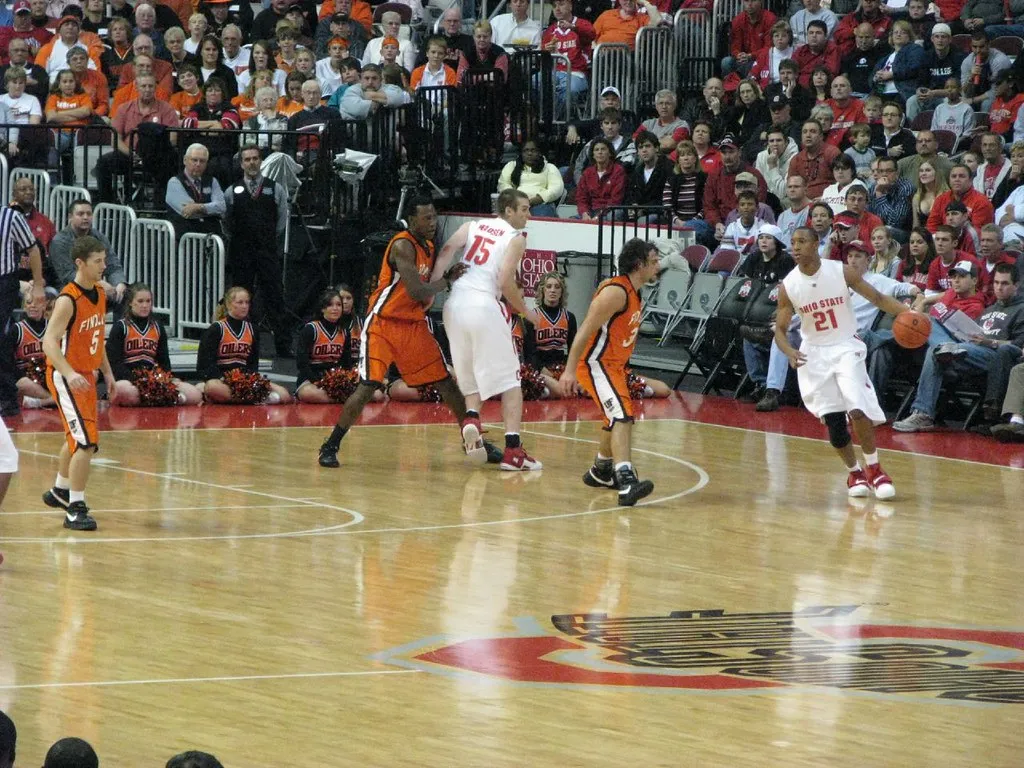
- Dribbling: you must dribble, or bounce, the ball to move with it.
- Traveling: taking more than the allowed steps without dribbling is a violation. In general, once you stop dribbling and hold the ball, you can pivot on one foot but not walk.
- Double dribble: dribbling with both hands at once, or picking up the ball and dribbling again, is a violation.
- Carrying (palming): turning your hand under the ball while dribbling is a violation, though officials vary in how strictly they call it.
Court areas and violations
- Out of bounds: the ball is out when it touches the boundary line or goes outside.
- Backcourt violation: once a team brings the ball into the front court, it cannot go back over the half-court line.
- Three seconds: in many leagues, an offensive player cannot stay in the paint for more than three seconds.
- Five-second and ten-second rules: limits on holding a ball when closely guarded, or crossing the half-court line, depending on the league.
- Goaltending: touching the ball on its way down to the basket, or after it hits the rim, is a violation.
Fouls
A foul is illegal physical contact. Common fouls include:
- Personal foul: hitting, pushing, or holding.
- Shooting foul: contact while a player is shooting results in free throws.
- Offensive foul: pushing off or charging into a defender.
- Technical foul: unsportsmanlike conduct.
Players usually foul out after a set number of fouls, such as five or six. Teams enter a bonus situation after a certain number of team fouls, which gives the opponent free throws.
Basic strategies
Offense: pass, move without the ball, set screens, and look for open shots. Defense: stay between your player and the basket, use your hands, communicate, and rebound.
Equipment
You need a ball, a hoop, and court shoes. See how to choose a basketball and basketball footwear basics.
Youth rules
Youth leagues often modify the rules, such as lower hoops, smaller balls, no pressing, and more playing time. Check with your league. See youth basketball coaching basics and basketball sizes by age.
Practice and fitness
Learn the skills at home. See dribbling drills at home and warm-up before playing basketball.
The takeaway
Shoot, dribble, pass, and play fair. Learn your league’s specifics and have fun. Our researched top-10 list lists balls and trainers with links to official pages.